Rock guide
Lake Superior agate
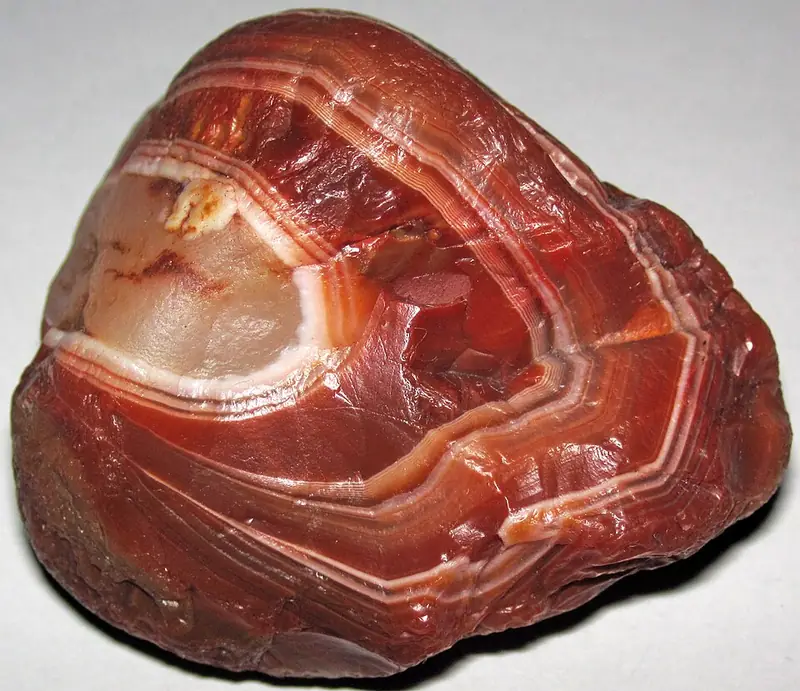
Bands of red and orange quartz, born in ancient lava and polished by Lake Superior.
How do Lake Superior agates form?
Agates are colorful banded rocks made mostly of chalcedony, a variety of quartz. Gas bubbles in lava left holes in the rock. Silica-rich water seeped in and filled them a layer at a time, making the bands, and different chemicals gave the bands different colors. Later the softer lava wore away and freed the harder agates.3
Their story starts about a billion years ago, when North America began to split and lava welled up where Lake Superior is now.2 The USGS dates most of those rift lavas to about 1,109 to 1,087 million years ago.1
Iron gives Lake Superior agates their main colors: red, orange and yellow. The layers often form rings like a tree's.2
How do you identify a Lake Superior agate?
- The bright bands usually hide inside. On the outside, look for a dull, waxy shine and a pitted, pock-marked surface, often red, orange or brown.3
- Hold it up to the light. Agates are translucent, so a little light should glow through.3
- Do not toss the plain ones too fast. An EGLE writer's favorite agate, from Grand Marais, was rusty brown and pitted with no bands outside, and came out of the tumbler beautifully banded.3
- Types to know: fortification agates, with layers like the walls of a fortress; eye agates, with circles like eyes; and moss agates, with tree-branch shapes inside.2
Not an agate: look-alikes
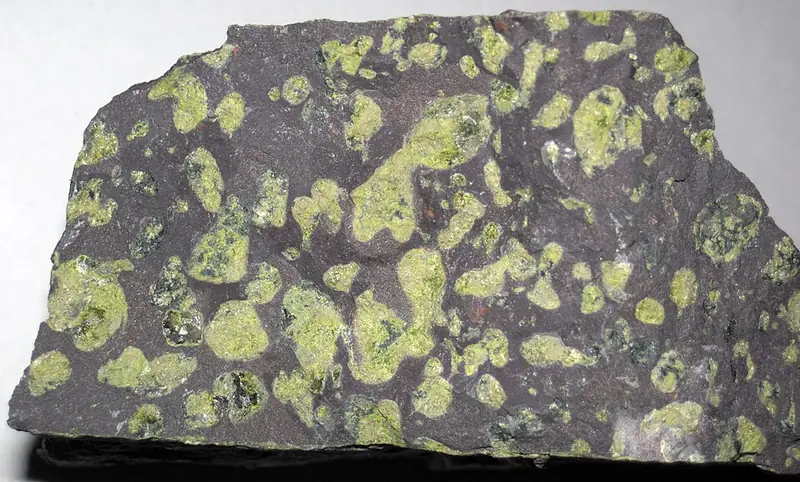
Jaspilite, plain chalcedony, laminated sandstone
Where can you find Lake Superior agates?
Agates turn up along the Upper Peninsula's Lake Superior shoreline, and in rivers with pebbles and gravel quarries. EGLE's tip: find a Lake Superior beach with lots of exposed pebbles and go after a storm.3
Official sources name Muskallonge Lake State Park,4 and an EGLE writer lists Grand Marais Beach, Pebble or Dog Beach in Marquette, Agate Beach in Toivola and Eagle River Beach among favorite agate places.3 See Where to hunt.
Glaciers carried agates far from the Lake Superior region, so people also look on riverbanks and at river mouths, in gravel pits, and anywhere pebbles pile up.2
To see great specimens, visit the A.E. Seaman Mineral Museum at Michigan Technological University in Houghton, or the Ernest Kemp Mineral Resources Museum at Lake Superior State University.3
Can I keep a Lake Superior agate?
On state land, agates count toward the 25 pound per person per year limit in R 299.922(hh).5 25 lb per year on state land
Pictured Rocks and Isle Royale do not allow it: see the national park rules.
Sources (5)
- U.S. Geological Survey, The Mesoproterozoic Midcontinent Rift System, Lake Superior region, USA (Ojakangas, Morey and Green, 2001). https://www.usgs.gov/publications/mesoproterozoic-midcontinent-rift-system-lake-superior-region-usa (checked October 21, 2026)
- Minnesota DNR, Lake Superior agate. https://www.dnr.state.mn.us/snapshots/rocks_minerals/lakesuperioragate.html (checked October 21, 2026)
- Michigan EGLE, Rockhounding. https://www.michigan.gov/egle/public/learn/geology/rockhounding (checked October 21, 2026)
- Michigan DNR, Muskallonge Lake State Park. https://www.michigan.gov/recsearch/parks/muskallonge (checked October 21, 2026)
- Michigan Administrative Code, R 299.921 to R 299.933, State Land Use Rules (Department of Natural Resources). https://ars.apps.lara.state.mi.us/AdminCode/DownloadAdminCodeFile?FileName=R+299.921+to+R+299.933.pdf (checked October 21, 2026)